
Tongkat Ali Side Effects: What the Trials Reported and Who Should Avoid It
Updated Published
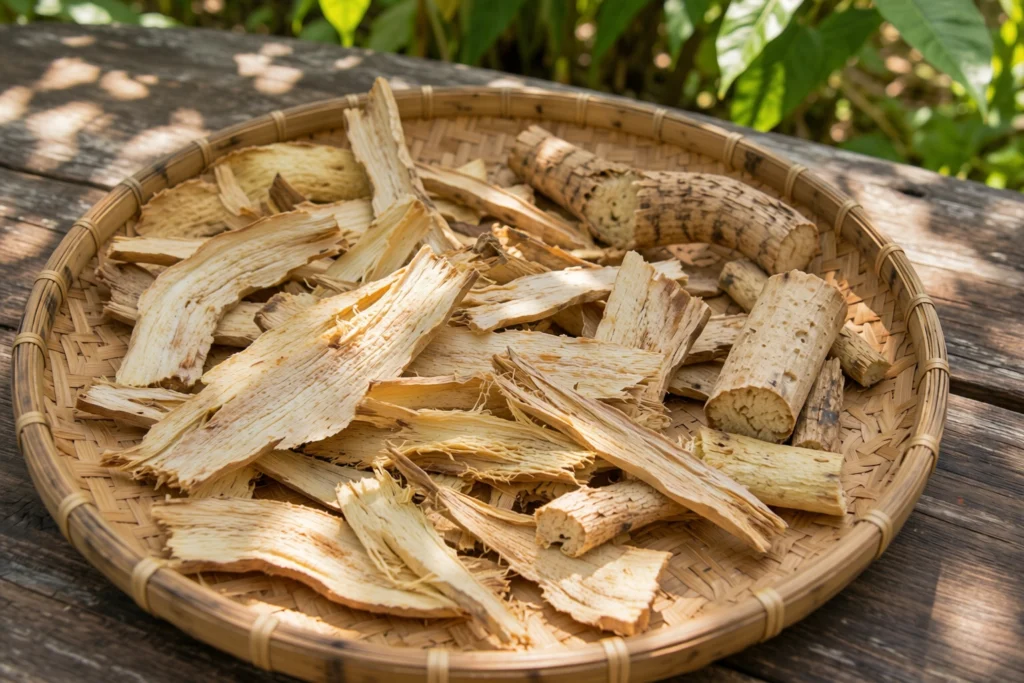
Short answer: in the human trials that reported on safety, which lasted from four to 24 weeks, side effects were few and mostly mild, usually stomach upset, and they were reported about as often on placebo as on tongkat ali. That is reassuring but limited: the trials were small, most were funded by an extract maker, and none was designed to find rare or long-term harms. In 2021 the European Food Safety Authority (EFSA) concluded that the safety of one standardised extract “has not been established”, because lab and high-dose animal tests showed DNA damage. Some products have also been found to contain too much mercury. Do not take it if you are pregnant or breastfeeding, and check with your doctor or pharmacist if you have a medical condition or take regular medicines.
This page sets out what each source actually found, so you can judge for yourself.
Side effects reported in human trials
Most tongkat ali trials tracked “adverse events”: anything that went wrong for a participant during the study, whether or not the supplement caused it. Comparing the tongkat ali group with the placebo group is what tells you whether the supplement is likely to be responsible.
| Study | Who took part | Daily dose | Length | What was reported |
|---|---|---|---|---|
| Ismail 2012 | 109 men aged 30 to 55 | 300 mg | 12 weeks | 11 adverse events in 11 men on tongkat ali, 20 in 15 men on placebo; all on tongkat ali judged unlikely to be caused by it. Blood tests, including liver function, similar to placebo |
| Chinnappan 2021 | 105 men aged 50 to 70 with low testosterone | 100 or 200 mg | 12 weeks | 8 adverse events in total. Mild stomach symptoms (constipation, indigestion, abdominal pain or discomfort, wind) in 6 men on tongkat ali, lasting 3 to 5 days; one case of itching. No clinically relevant changes in blood, liver or kidney tests |
| Talbott 2013 | 63 moderately stressed adults | 200 mg | 4 weeks | 3 people felt unusually tired in the first two weeks (2 on tongkat ali, 1 on placebo). No other side effects; no change in liver markers |
| George 2018 | 93 moderately stressed adults | 50 mg, with multivitamins | 24 weeks | 13 adverse events: 7 on the supplement, 6 on placebo. No significant changes in vital signs or blood chemistry |
| Chen 2014 | 13 male recreational athletes | 400 mg | 6 weeks | No changes in liver or kidney function tests |
A few things to keep in mind:
- Stomach upset is the side effect most likely to be real. It is the only side effect that clustered in a tongkat ali group (six men in the 2021 trial, none in the placebo group), and the authors of the 2021 trial noted it as a finding worth checking in larger studies.
- The numbers are small. Only about 220 people took tongkat ali across these five trials. A side effect that affects one person in a thousand would almost certainly have been missed.
- Most were industry-funded. The 2012 and 2021 trials were funded by the maker of the extract tested, and at least one author of the 2013 and 2018 trials worked for that company.
- They used one kind of product. All five tested the same branded, standardised water extract (Physta). Results may not apply to other extracts, raw root powder or blended products.
Rare problems reported in single cases
Two single-patient case reports describe serious problems in men taking tongkat ali:
- Liver injury. A 2024 report describes a 47-year-old man who developed jaundice and raised liver enzymes shortly after starting tongkat ali, and improved after stopping it. The authors called it the first reported case of its kind.
- Heart rhythm. A 2025 report describes a 71-year-old man who developed a fast, abnormal heart rhythm (atrial flutter) after starting tongkat ali, with no other cause found.
A single case cannot prove the supplement was the cause, or rule out a contaminated product. But they are a reason to stop and see a doctor if you notice yellowing of the skin or eyes, dark urine, palpitations or dizziness.
The EFSA 2021 safety opinion
In 2021 the European Food Safety Authority assessed a standardised tongkat ali root water extract, proposed as a food supplement at up to 200 mg a day for adults other than pregnant and breastfeeding women.
- A lab test on cells showed the extract could damage chromosomes.
- In a follow-up test in rats, the highest dose (2,000 mg per kg of body weight, far above what anyone would take) caused DNA damage in the stomach and the first part of the small intestine, the first tissues the extract reaches.
- EFSA concluded the extract “has the potential to induce DNA damage, which is of concern”, and that its safety “has not been established under any condition of use”.
This does not show that tongkat ali harms people at normal doses. It does mean the long-term safety question is open, and it is one reason we suggest staying within the label dose rather than taking more.

Heavy metals and product quality

A Malaysian study tested 100 products containing tongkat ali and found that 26% contained 0.53 to 2.35 ppm of mercury, more than the 0.5 ppm limit Malaysia sets for traditional medicines. Most of those products were not registered with the Malaysian regulator.
Contamination is a property of the product, not the plant, so it varies from seller to seller. Before you buy, ask where the root comes from, how the extract is made, and whether each batch is tested for heavy metals. Ours has a batch certificate with lead, mercury, arsenic and cadmium results, all within limits (available on request). We cover how to judge a product in choosing a tongkat ali brand in Australia.
Does tongkat ali interact with medicines?
Only one interaction has been tested in people. In a 2010 study, 14 healthy young men took a single dose of propranolol (a beta-blocker) with either 200 mg of a tongkat ali water extract or a placebo. With tongkat ali, the amount of propranolol absorbed fell by 29% and the peak level by 42%, and it took longer to reach that peak. The authors put this down to reduced absorption and advised caution when the two are taken together.
No other interactions have been studied in people. That is not the same as there being none. Because tongkat ali may affect hormone levels, it makes sense to ask your doctor or pharmacist before taking it with:
- any prescription medicine, especially one where the dose has to be exact;
- hormone treatments, including testosterone, DHEA or treatments for a hormone-sensitive condition (see combining DHEA and tongkat ali);
- other supplements aimed at hormones, which makes it harder to tell what is causing a side effect.
Who should not take tongkat ali
- Pregnant or breastfeeding women. It has not been studied in pregnancy or breastfeeding, and EFSA’s assessment excluded them. Avoid it.
- Children and teenagers. The trials were in adults only.
- People with a hormone-sensitive condition, or a history of one: talk to your doctor first, as tongkat ali may raise testosterone.
- People with liver, kidney or heart conditions, or anyone taking regular medicines: ask your doctor or pharmacist first.
- Competitive athletes: check any supplement with your sporting body.
How to lower your risk
- Start at the low end of the label dose and give it a week before deciding whether to stay there. Extract strengths differ, so follow the label of your product; trials of concentrated extracts used 100 mg to 600 mg a day. See tongkat ali dosage and cycling.
- If it upsets your stomach, try it after a meal; see taking tongkat ali with or without food.
- Do not take more than the label says. More is not better, and the safety evidence for high doses is weakest.
- Choose a product that tells you its extract ratio, its standardisation and how it is tested for heavy metals.
- Take one new supplement at a time, so you can tell what is doing what.
If you get a side effect
Stop taking it. Mild stomach upset usually settles within days. See your GP if a symptom is severe, does not settle, or is one of the warning signs above (yellow skin or eyes, dark urine, palpitations, dizziness). You can also report a suspected side effect of a medicine or supplement to the TGA through its adverse event reporting page for consumers.
Frequently asked questions
Is tongkat ali safe to take every day?
The trials gave it daily for four to 24 weeks and did not find a pattern of side effects beyond mild stomach upset. Daily use beyond that has not been studied for safety, and EFSA said the safety of the extract it reviewed has not been established. If you plan to take it long term, see tongkat ali dosage and cycling for how people build in breaks.
Is tongkat ali bad for your liver?
Trials that checked liver function, over six to twelve weeks, found no clinically relevant changes. There is one 2024 case report of liver injury in a man taking tongkat ali. If you have a liver condition, ask your doctor before taking it.
Can tongkat ali cause hair loss?
No study has shown that it does. The concern is theoretical and depends on whether it raises testosterone and then DHT; we go through it in tongkat ali and hair loss.
Does tongkat ali keep you awake?
None of the trials above reported trouble sleeping. Some people still prefer to take it in the morning; see the best time to take tongkat ali.
Are the side effects different for women?
The 2013 and 2018 trials included women, but research in women is limited. Women who are pregnant, trying to conceive or breastfeeding should not take it. More in tongkat ali for women.
If you decide to try it, our tongkat ali root extract is a single-ingredient water extract of Sumatran root, standardised to 2% eurycomanone, with a 60 Day Wellness Guarantee.
Sources
- Ismail SB, Wan Mohammad WM, George A, et al. Randomized clinical trial on the use of PHYSTA freeze-dried water extract of Eurycoma longifolia for the improvement of quality of life and sexual well-being in men. Evidence-Based Complementary and Alternative Medicine, 2012.
- Chinnappan SM, George A, Pandey P, et al. Effect of Eurycoma longifolia standardised aqueous root extract-Physta on testosterone levels and quality of life in ageing male subjects: a randomised, double-blind, placebo-controlled multicentre study. Food & Nutrition Research, 2021.
- Talbott SM, Talbott JA, George A, et al. Effect of Tongkat Ali on stress hormones and psychological mood state in moderately stressed subjects. Journal of the International Society of Sports Nutrition, 2013.
- George A, Udani J, Abidin NZ, et al. Efficacy and safety of Eurycoma longifolia (Physta) water extract plus multivitamins on quality of life, mood and stress: a randomized placebo-controlled and parallel study. Food & Nutrition Research, 2018.
- Chen CK, Mohamad WM, Ooi FK, et al. Supplementation of Eurycoma longifolia Jack extract for 6 weeks does not affect urinary testosterone: epitestosterone ratio, liver and renal functions in male recreational athletes. International Journal of Preventive Medicine, 2014.
- Kaliounji A, Shadid G, Saba H, et al. A rare case of tongkat ali-induced liver injury: a case report. Cureus, 2024.
- Ali M. Tongkat Ali-induced atrial flutter: a probable case. Cureus, 2025.
- EFSA Panel on Nutrition, Novel Foods and Food Allergens. Safety of Eurycoma longifolia (Tongkat Ali) root extract as a novel food. EFSA Journal, 2021.
- Ang HH, Lee KL. Contamination of mercury in tongkat Ali hitam herbal preparations. Food and Chemical Toxicology, 2006.
- Salman SA, Amrah S, Wahab MS, et al. Modification of propranolol’s bioavailability by Eurycoma longifolia water-based extract. Journal of Clinical Pharmacy and Therapeutics, 2010.