Herbs for Testosterone: 6 Popular Options Graded by the Evidence
Updated Published
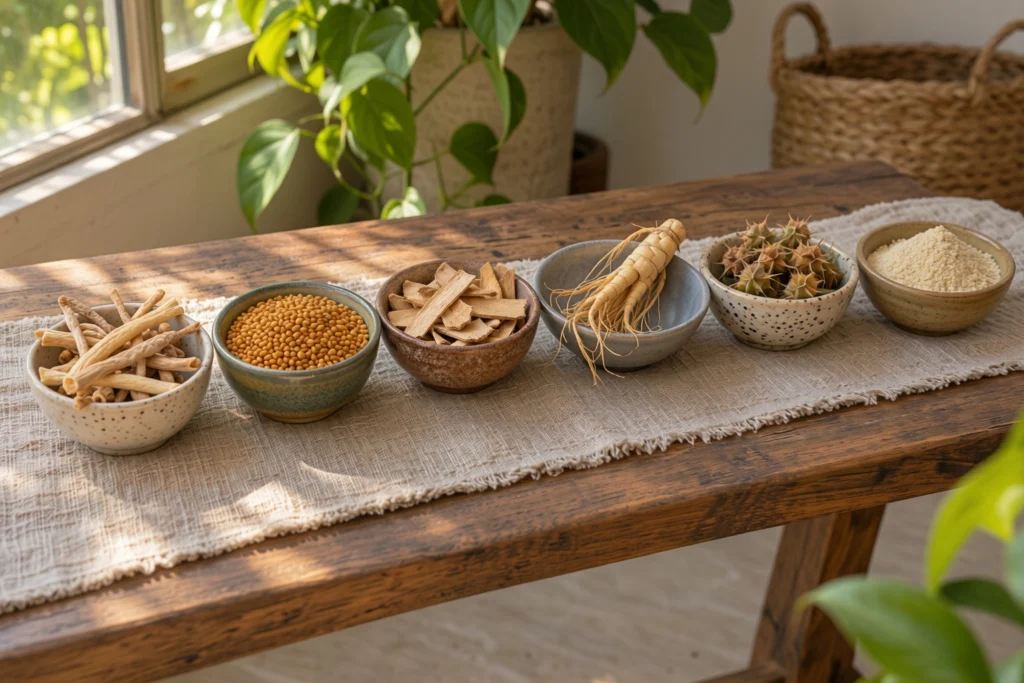
Short answer: of the herbs most often sold for testosterone, only a few have human trials showing a rise, and the rises are modest. Ashwagandha and fenugreek have the most trials; tongkat ali has a smaller set with a positive meta-analysis; ginseng has a little; tribulus and maca have trials that found no effect on testosterone. None has strong, long-term evidence, and most “testosterone booster” products mix many ingredients that have never been tested for it. If you think your testosterone is low, a morning blood test with your GP is the place to start.
The six herbs at a glance
| Herb | What human studies found on testosterone | Typical studied dose | Our evidence grade | Main safety notes |
|---|---|---|---|---|
| Ashwagandha | Higher in men in a meta-analysis of 23 trials (average about 57 ng/dL) | 600 mg a day of root extract | Moderate | Rare serious liver injury; may affect thyroid levels |
| Fenugreek | A small rise in total testosterone, very uncertain; no clear effect on free testosterone | Varies between extracts | Low | Little safety data in the reviews |
| Tongkat ali | Higher total testosterone in a meta-analysis of five trials, clearest when levels were low | 100-600 mg a day of extract | Low to moderate | Long-term safety not well studied; may lower propranolol absorption |
| Ginseng (Asian red) | “Some evidence” in one review; one small study found no change | 1-2 g a day of root extract | Low | Mild headache, sleep and stomach upsets; warfarin interaction reports |
| Tribulus | No clear effect on testosterone | Varies | Very low (for testosterone) | No toxicity reported in seven small studies |
| Maca | No effect on testosterone in a 12-week trial | 1.5-3 g a day | Very low (for testosterone) | Can interfere with some testosterone blood tests |
Grades are our summary of the reviews below: “moderate” means several randomised trials pointing the same way, still mostly small and short; “low” means few or inconsistent trials; “very low” means little evidence of any effect on testosterone.
The best overview we found is a 2021 systematic review of 32 randomised trials of 13 herbs. Only 9 of the 32 showed a statistically significant rise in testosterone, only 6 were judged at low risk of bias, and half were in men under 40. Fenugreek and ashwagandha had the most consistent positive results.
Ashwagandha
Ashwagandha (Withania somnifera) is a shrub used in Ayurvedic tradition. A 2026 meta-analysis of 23 randomised trials (1,706 people) found higher testosterone in men taking it, by about 57 ng/dL on average, but not in women; cortisol was lower. In one trial of 57 overweight men aged 40 to 70, eight weeks of an extract was linked with a 14.7% greater rise in salivary testosterone than placebo, with no difference in how tired or energetic the men felt.
Safety: a 2026 review found 25 published cases of liver injury linked to ashwagandha; most recovered after stopping, but there was one transplant and three deaths in people with existing cirrhosis. The meta-analysis also found a modest rise in the thyroid hormone T4. More in tongkat ali vs ashwagandha.
Fenugreek
Fenugreek (Trigonella foenum-graecum) is a seed better known as a cooking spice. A 2020 meta-analysis of four trials found higher total testosterone with fenugreek extract. A larger 2026 review of 13 trials found only a small effect on total testosterone, an unclear effect on free testosterone, no trials at low risk of bias, and “very low” certainty; the authors said current evidence does not support testosterone-boosting claims. So fenugreek’s grade depends on which review you read, which is itself a sign the evidence is weak.
Tongkat ali
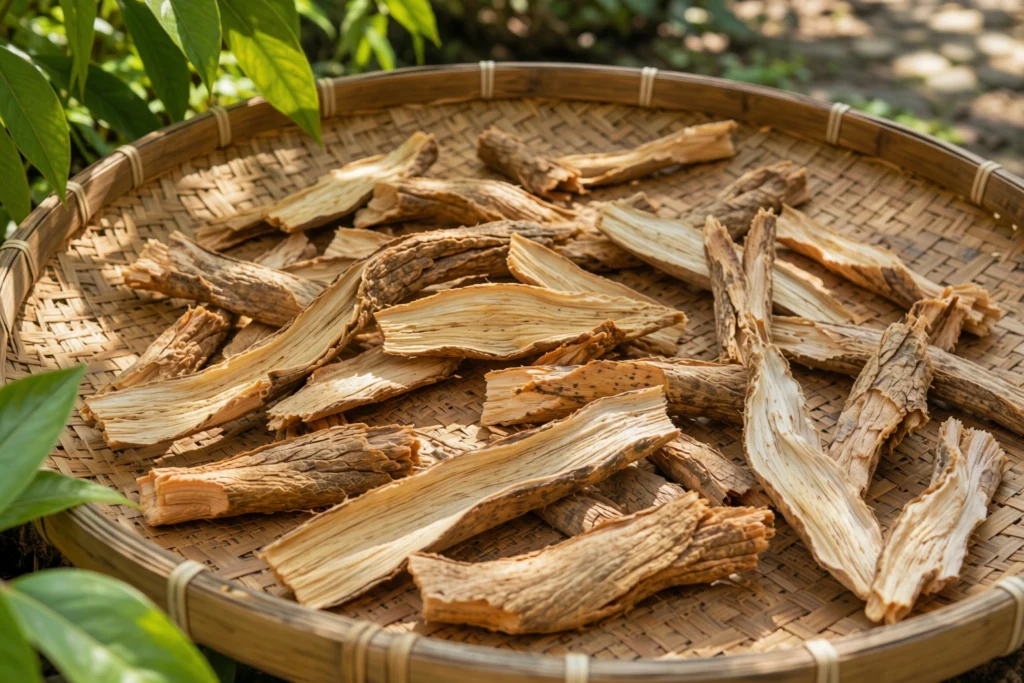
Tongkat ali (Eurycoma longifolia) is a Southeast Asian shrub whose root is sold as a water extract. A 2022 meta-analysis of five randomised trials found higher total testosterone in men after supplementation, clearest in men whose testosterone was low to begin with. In 32 healthy young men, 600 mg a day for two weeks raised total and free testosterone compared with placebo. In 63 moderately stressed adults, four weeks of an extract gave 16% lower salivary cortisol and 37% higher salivary testosterone than placebo. The trials are small and short, and the authors of the meta-analysis said more research is needed.
Safety: long-term safety has not been well studied: the human trials have been small and short, mostly two to six weeks, and were not designed to find rare or long-term harms. Tongkat ali also cut the absorption of the beta-blocker propranolol by 29% in 14 healthy men, and a Malaysian study found 26% of 100 tongkat ali products had more mercury than the local limit. Ours has a batch certificate with lead, mercury, arsenic and cadmium results, all within limits (available on request). More in the benefits of tongkat ali and the side effects of tongkat ali.
Ginseng
Panax ginseng is a root from Korea and China. The 2021 review found “some evidence” for Asian red ginseng and testosterone, but far less than for ashwagandha or fenugreek. In a small study, eight male students who took 20 g of ginseng root extract after weights had the same testosterone response as those who had water. Ginseng’s main research area is tiredness, where reviews call the evidence insufficient.
Safety: a review found side effects in trials were about as common as with placebo (mostly headache, sleep problems and stomach upsets), with reported interactions with warfarin, phenelzine and alcohol. More in tongkat ali vs ginseng.
Tribulus terrestris
Tribulus (known as gokshura in Ayurveda) is one of the most heavily marketed testosterone herbs and one of the weakest on the evidence. A 2016 review concluded that the idea that tribulus raises androgens is, at best, inconclusive, and that the evidence they reviewed proved it wrong. A 2022 systematic review of seven studies in active men found no clear effect on hormones or muscle damage markers, and no toxicity reported. A 2019 review agreed: tribulus was not supported for raising testosterone in men.
Maca
Maca (Lepidium meyenii) is an Andean root. In a 12-week trial in healthy men, 1.5 g or 3 g a day made no difference to testosterone or any other reproductive hormone measured, though men reported more sexual desire. A 2019 review also found maca was not supported for raising testosterone. Maca has been reported to interfere with some testosterone blood tests, so mention it if you have one. More in maca vs tongkat ali.
What about vitamin D, ginger and “testosterone booster” products?
These come up in the same searches, so briefly:
- Vitamin D. In 54 overweight men low in vitamin D, 3,332 IU a day for a year was followed by higher testosterone, compared with no change on placebo. But in 98 healthy men with normal testosterone and lowish vitamin D, 20,000 IU a week for 12 weeks made no difference. If you are low in vitamin D, fixing that is worthwhile for its own sake; it is unlikely to change testosterone if your levels are normal. See healthdirect on vitamin D and your health.
- Ginger. A 2018 review found that the research linking ginger to testosterone is mostly in animals, and that the effect “is not yet confirmed in humans”.
- Over-the-counter “T booster” products. A study of 50 such products found 90% claimed to raise testosterone, with an average of eight ingredients each. For 61.5% of the ingredients there was no published data on testosterone at all, and only 24.8% had data showing a rise; 10.1% had data suggesting a fall. Thirteen products had more zinc, vitamin B3 or magnesium than the US upper limit.
Before you try any of them

- Get tested first if you are worried. Healthdirect advises that testosterone is best tested early in the morning, and that a low result needs a second test to confirm it. A real deficiency is a medical issue for your doctor, not something to manage with herbs.
- One at a time. Multi-herb products make it impossible to know what you are reacting to, and no combination has been tested.
- Pregnancy, breastfeeding, medicines. Avoid these herbs as supplements during pregnancy and breastfeeding. If you take prescription medicines or have a medical condition, check with your doctor or pharmacist first.
- Combining with other hormone supplements. DHEA is a hormone, not a herb, and raises its own issues; see combining DHEA and tongkat ali.
We sell one of these, tongkat ali, so read our grades with that in mind; we have tried to grade it no more kindly than the others. If you decide to try it, our tongkat ali root extract is a single-ingredient 200:1 water extract, standardised to 2% eurycomanone, with a 60 Day Wellness Guarantee. Its label directions are one to two 500 mg capsules a day.
Frequently asked questions
Which herb has the most evidence for testosterone?
Ashwagandha has the most randomised trials showing a rise in men, followed by fenugreek and tongkat ali. All the effects are modest and the trials short.
Do testosterone herbs actually work?
Some raise testosterone a little in some trials, especially in men whose levels were low. Tribulus and maca do not appear to. If your testosterone is actually low, that is a matter for your doctor.
Is tribulus or tongkat ali better?
Tongkat ali has trials showing a rise in total testosterone; tribulus reviews found no clear effect on testosterone.
Is fenugreek or tongkat ali better for testosterone?
They have similar, modest evidence, and reviews disagree about fenugreek. Neither has been compared head to head.
Sources
- Smith SJ, Lopresti AL, Teo SYM, et al. Examining the effects of herbs on testosterone concentrations in men: a systematic review. Advances in Nutrition, 2021.
- Fornalik M, Malkiewicz A, Adamczak D, et al. Hormonal modulation with Withania somnifera: systematic review and meta-analysis of randomized-controlled trials. Planta Medica, 2026.
- Lopresti AL, Drummond PD, Smith SJ. A randomized, double-blind, placebo-controlled, crossover study examining the hormonal and vitality effects of ashwagandha (Withania somnifera) in aging, overweight males. American Journal of Men’s Health, 2019.
- McIntyre D, Nguyen P, Kim Y, et al. Ashwagandha (Withania somnifera)-associated liver injury: a scoping review of clinical characteristics and safety considerations. Cureus, 2026.
- Mansoori A, Hosseini S, Hosseini S, et al. Effect of fenugreek extract supplement on testosterone levels in male: a meta-analysis of clinical trials. Phytotherapy Research, 2020.
- Yang P, Niu Z, Guo J, et al. Effects of oral fenugreek-derived preparations on testosterone-related outcomes in adult men: a systematic review and meta-analysis of randomized placebo-controlled trials. Frontiers in Nutrition, 2026.
- Leisegang K, Finelli R, Sikka SC, et al. Eurycoma longifolia (Jack) improves serum total testosterone in men: a systematic review and meta-analysis of clinical trials. Medicina, 2022.
- Chan KQ, Stewart C, Chester N, et al. The effect of Eurycoma longifolia on the regulation of reproductive hormones in young males. Andrologia, 2021.
- Talbott SM, Talbott JA, George A, et al. Effect of Tongkat Ali on stress hormones and psychological mood state in moderately stressed subjects. Journal of the International Society of Sports Nutrition, 2013.
- Salman SA, Amrah S, Wahab MS, et al. Modification of propranolol’s bioavailability by Eurycoma longifolia water-based extract. Journal of Clinical Pharmacy and Therapeutics, 2010.
- Ang HH, Lee KL. Contamination of mercury in tongkat Ali hitam herbal preparations. Food and Chemical Toxicology, 2006.
- Youl Kang H, Hwan Kim S, Jun Lee W, et al. Effects of ginseng ingestion on growth hormone, testosterone, cortisol, and insulin-like growth factor 1 responses to acute resistance exercise. Journal of Strength and Conditioning Research, 2002.
- Lee NH, Yoo SR, Kim HG, et al. Safety and tolerability of Panax ginseng root extract: a randomized, placebo-controlled, clinical trial in healthy Korean volunteers. Journal of Alternative and Complementary Medicine, 2012.
- Coon JT, Ernst E. Panax ginseng: a systematic review of adverse effects and drug interactions. Drug Safety, 2002.
- Neychev V, Mitev V. Pro-sexual and androgen enhancing effects of Tribulus terrestris L.: fact or fiction. Journal of Ethnopharmacology, 2016.
- Fernández-Lázaro D, Fernandez-Lazaro CI, Seco-Calvo J, et al. Effects of Tribulus terrestris L. on sport and health biomarkers in physically active adult males: a systematic review. International Journal of Environmental Research and Public Health, 2022.
- Santos HO, Howell S, Teixeira FJ. Beyond tribulus (Tribulus terrestris L.): the effects of phytotherapics on testosterone, sperm and prostate parameters. Journal of Ethnopharmacology, 2019.
- Gonzales GF, Córdova A, Vega K, et al. Effect of Lepidium meyenii (maca), a root with aphrodisiac and fertility-enhancing properties, on serum reproductive hormone levels in adult healthy men. Journal of Endocrinology, 2003.
- Gonzales GF, Córdova A, Vega K, et al. Effect of Lepidium meyenii (maca) on sexual desire and its absent relationship with serum testosterone levels in adult healthy men. Andrologia, 2002.
- Srikugan L, Sankaralingam A, McGowan B. First case report of testosterone assay-interference in a female taking maca (Lepidium meyenii). BMJ Case Reports, 2011.
- Pilz S, Frisch S, Koertke H, et al. Effect of vitamin D supplementation on testosterone levels in men. Hormone and Metabolic Research, 2011.
- Lerchbaum E, Pilz S, Trummer C, et al. Vitamin D and testosterone in healthy men: a randomized controlled trial. Journal of Clinical Endocrinology and Metabolism, 2017.
- Banihani SA. Ginger and testosterone. Biomolecules, 2018.
- Clemesha CG, Thaker H, Samplaski MK. ‘Testosterone boosting’ supplements composition and claims are not supported by the academic literature. World Journal of Men’s Health, 2020.
- healthdirect Australia. Testosterone.
- healthdirect Australia. Vitamin D and your health.