Tongkat Ali vs Ashwagandha: What the Research Shows for Men
Updated Published
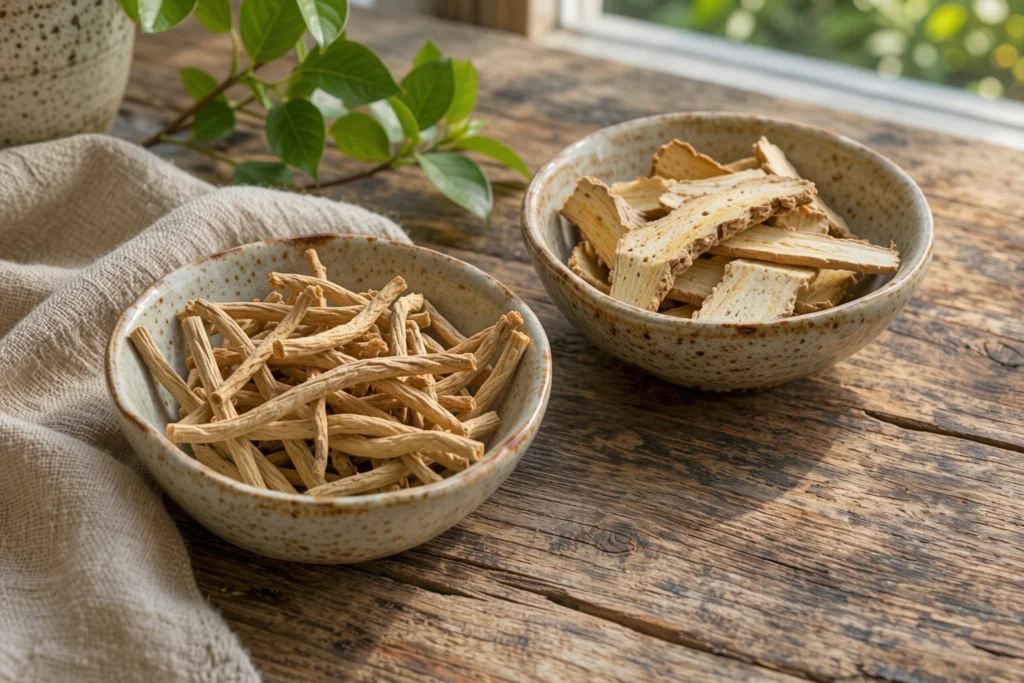
Short answer: ashwagandha has more human research than tongkat ali, and both have trials showing higher testosterone and lower cortisol in some groups of men. Ashwagandha’s trials are more numerous and more often about stress; tongkat ali’s are fewer and smaller, mostly about testosterone. Neither has long-term evidence, and each has its own safety concern: rare liver injury with ashwagandha, and long-term safety that has not been well studied for tongkat ali. Nobody has tested taking them together.
Tongkat ali and ashwagandha at a glance
| Tongkat ali | Ashwagandha | |
|---|---|---|
| What it is | Root of Eurycoma longifolia, a Southeast Asian shrub, usually sold as a water extract | Root (sometimes root and leaf) of Withania somnifera, a shrub used in Ayurvedic tradition |
| What human studies measured | Testosterone, cortisol, mood scores, strength | Stress scores, cortisol, testosterone, strength with training |
| Typical studied dose | 100-600 mg a day of extract, for two to six weeks in most trials | 600 mg a day of root extract (300 mg twice a day) in several trials, for 8 weeks or so |
| Evidence strength | Low to moderate: a meta-analysis of five small trials | Moderate for cortisol and testosterone (a meta-analysis of 23 trials); low for strength |
| Main safety notes | Long-term safety not well studied; may lower absorption of propranolol; quality varies | Rare but serious liver injury reported; may affect thyroid hormone levels |
Tongkat ali vs ashwagandha for testosterone
Both have been studied, and both have pooled results pointing the same way.
- Tongkat ali. A 2022 meta-analysis of five randomised trials found higher total testosterone in men after supplementation, clearest in men whose testosterone was low to begin with. In 32 healthy young men, 600 mg a day for two weeks raised total and free testosterone compared with placebo.
- Ashwagandha. A 2026 meta-analysis of 23 randomised trials (1,706 people) found testosterone was higher in men taking ashwagandha, by an average of about 57 ng/dL, but not in women. In a trial of 57 overweight men aged 40 to 70, eight weeks of an ashwagandha extract was linked with a 14.7% greater rise in salivary testosterone than placebo, but there was no difference in how tired, energetic or sexually well the men felt.
A 2021 systematic review of herbs and testosterone in men listed ashwagandha among the two herbs with the most consistent positive results, while noting small trials, half of them in men under 40, and few studies at low risk of bias. So on testosterone, ashwagandha has the larger body of evidence. In both cases the changes were modest, and a higher number on a test is not the same as feeling different.
If you think your testosterone is low, see your GP for a blood test; we explain the numbers in testosterone levels in Australia.
Tongkat ali vs ashwagandha for stress
This is ashwagandha’s main research area.
- Ashwagandha. In 64 adults with a history of chronic stress, 300 mg of root extract twice a day for 60 days gave lower scores on every stress questionnaire used and lower blood cortisol than placebo. The 23-trial meta-analysis also found lower cortisol overall.
- Tongkat ali. In 63 moderately stressed adults, four weeks of a tongkat ali extract gave 16% lower salivary cortisol and 37% higher salivary testosterone than placebo, with better scores for tension, anger and confusion. It is one small study.
Day-to-day stress is not the same as an anxiety disorder or depression. If stress is affecting your sleep, work or relationships, talk to your GP; no supplement here has been shown to treat a mental health condition.
Tongkat ali vs ashwagandha for strength and training
- Ashwagandha. In 57 young men new to weight training, 300 mg twice a day for eight weeks was followed by bigger strength gains than placebo (bench press up 46 kg vs 26 kg). But a 2026 meta-analysis that pooled the training trials rated the certainty as low and said the evidence does not establish a meaningful effect.
- Tongkat ali. In 25 active adults aged 57 to 72, 400 mg a day for five weeks was followed by higher handgrip strength in a small pilot study. In 18 rugby players, a week of 400 mg a day made no difference to soreness or recovery after hard exercise.
Neither is proven to build strength. Training and protein matter far more; see turkesterone vs tongkat ali for the gym question in more detail.
Can you take tongkat ali and ashwagandha together?
No study has tested them together, so there is no evidence on what the combination does or whether it is safe. Both can shift hormones, so if you want to try both:
- Start one, give it a few weeks, then add the other if you still want to, so you know which one you are reacting to.
- Keep to the label dose of each, and don’t take a combined product that doesn’t say how much of each is in it.
- Stop both if you feel unwell, and see a doctor if you notice yellowing of the skin or eyes, dark urine or itching (signs of the liver problem described below).
Safety
- Ashwagandha and the liver. A 2026 review of published case reports found 25 people with liver injury linked to ashwagandha. It usually appeared after weeks of use, and most people recovered after stopping, but one needed a liver transplant and three people with existing cirrhosis died. The reviewers said people with advanced liver disease should avoid it.
- Ashwagandha and the thyroid. The 23-trial meta-analysis found a modest rise in the thyroid hormone T4. If you have a thyroid condition or take thyroid medicine, ask your doctor first.
- Tongkat ali, long-term safety has not been well studied. The human trials have been small and short, mostly two to six weeks, and were not designed to find rare or long-term harms.
- Tongkat ali and medicines. In 14 healthy young men, 200 mg of tongkat ali extract cut the absorption of the beta-blocker propranolol by 29%.
- Quality. A Malaysian study of 100 tongkat ali products found 26% had more mercury than the local limit. Ours has a batch certificate with lead, mercury, arsenic and cadmium results, all within limits (available on request).
- Both: avoid during pregnancy and breastfeeding. If you take prescription medicines or have a medical condition, check with your doctor or pharmacist first.
More in the side effects of tongkat ali and how to use tongkat ali.
Which should you choose?
- If stress is the main reason you are looking, ashwagandha has more trials on it, but weigh the liver reports.
- If testosterone is your question, both have modest pooled results; ashwagandha’s evidence base is larger, tongkat ali’s is smaller and shorter.
- If you have liver or thyroid problems, or take regular medicines, talk to your doctor before either.
We sell tongkat ali, not ashwagandha, so read our view with that in mind. If you decide to try it, our tongkat ali root extract is a single-ingredient 200:1 water extract of Sumatran root, standardised to 2% eurycomanone, with a 60 Day Wellness Guarantee. Its label directions are one to two 500 mg capsules a day.
Frequently asked questions
Is ashwagandha or tongkat ali better for testosterone?
Both have trials showing modest rises. Ashwagandha has more trials; tongkat ali’s effect was clearest in men whose testosterone was low to start with. Neither has long-term evidence.
Can I take tongkat ali and ashwagandha at the same time?
It has not been studied. If you try both, add them one at a time and check with a pharmacist if you take medicines.
Should I take them in the morning or at night?
The trials don’t tell us. Several ashwagandha trials split the dose into two a day; for tongkat ali, see taking tongkat ali before bed.
Is ashwagandha safe?
In the stress trial above, side effects were mild and similar to placebo, but rare serious liver injury has been reported. Avoid it in pregnancy, and if you have liver disease.
Sources
- Leisegang K, Finelli R, Sikka SC, et al. Eurycoma longifolia (Jack) improves serum total testosterone in men: a systematic review and meta-analysis of clinical trials. Medicina, 2022.
- Chan KQ, Stewart C, Chester N, et al. The effect of Eurycoma longifolia on the regulation of reproductive hormones in young males. Andrologia, 2021.
- Fornalik M, Malkiewicz A, Adamczak D, et al. Hormonal modulation with Withania somnifera: systematic review and meta-analysis of randomized-controlled trials. Planta Medica, 2026.
- Lopresti AL, Drummond PD, Smith SJ. A randomized, double-blind, placebo-controlled, crossover study examining the hormonal and vitality effects of ashwagandha (Withania somnifera) in aging, overweight males. American Journal of Men’s Health, 2019.
- Smith SJ, Lopresti AL, Teo SYM, et al. Examining the effects of herbs on testosterone concentrations in men: a systematic review. Advances in Nutrition, 2021.
- Chandrasekhar K, Kapoor J, Anishetty S. A prospective, randomized double-blind, placebo-controlled study of safety and efficacy of a high-concentration full-spectrum extract of ashwagandha root in reducing stress and anxiety in adults. Indian Journal of Psychological Medicine, 2012.
- Talbott SM, Talbott JA, George A, et al. Effect of Tongkat Ali on stress hormones and psychological mood state in moderately stressed subjects. Journal of the International Society of Sports Nutrition, 2013.
- Wankhede S, Langade D, Joshi K, et al. Examining the effect of Withania somnifera supplementation on muscle strength and recovery: a randomized controlled trial. Journal of the International Society of Sports Nutrition, 2015.
- Lee JC, Heo AS. Adjunctive ashwagandha (Withania somnifera) supplementation and resistance-training adaptations in healthy adults: a systematic review and random-effects meta-analysis. Nutrients, 2026.
- Henkel RR, Wang R, Bassett SH, et al. Tongkat Ali as a potential herbal supplement for physically active male and female seniors: a pilot study. Phytotherapy Research, 2014.
- Zakaria AZ, Washif JA, Lim BH, et al. Effects of Eurycoma longifolia Jack supplementation on eccentric leg press exercise-induced muscle damage in rugby players. Biology of Sport, 2023.
- McIntyre D, Nguyen P, Kim Y, et al. Ashwagandha (Withania somnifera)-associated liver injury: a scoping review of clinical characteristics and safety considerations. Cureus, 2026.
- Salman SA, Amrah S, Wahab MS, et al. Modification of propranolol’s bioavailability by Eurycoma longifolia water-based extract. Journal of Clinical Pharmacy and Therapeutics, 2010.
- Ang HH, Lee KL. Contamination of mercury in tongkat Ali hitam herbal preparations. Food and Chemical Toxicology, 2006.