
How to Use Tongkat Ali: Forms, Daily Dose and When to Take It
Updated Published
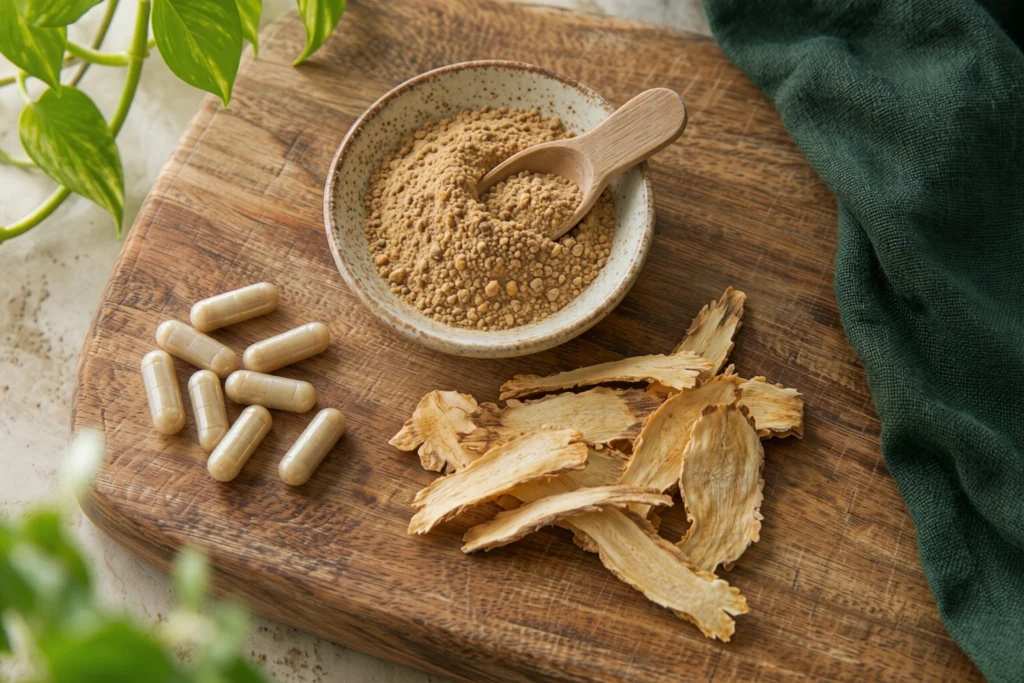
Short answer: most people take tongkat ali as a capsule of standardised root extract, once a day, in the morning, with or without breakfast. Trials of concentrated extracts used 100 mg to 600 mg a day; start at the low end of the label dose and follow the label of the product you have, because strengths vary a lot. Take it every day for at least a few weeks before you judge it, and do not take it if you are pregnant or breastfeeding. The rest of this guide covers each choice in a little more detail, with links to our longer articles on dose, timing and safety.
How to take tongkat ali: the short version
- Choose a standardised root extract with a stated extract ratio and eurycomanone content.
- Start with the lower end of the label dose for a week.
- Take it at the same time each day, usually in the morning.
- Take it with or without food; after a meal if it upsets your stomach.
- Give it eight to twelve weeks, then decide whether to keep going.
- Build in breaks if you take it long term.
Which form: capsules, powder or tea
Capsules
Capsules are the simplest way to take it. The dose is measured for you, and you do not taste it. Check how many milligrams of extract each capsule holds, not just the capsule size, and whether there are fillers or other ingredients.
Powder
Extract powder costs less per dose and can be mixed into drinks, but it is very bitter and easy to overdo. Extract powders are concentrated, so use a measuring scoop or scale rather than a teaspoon. Most people mix it into a smoothie or coffee; see tongkat ali coffee. Raw root powder (ground root that has not been extracted) is a different product, much weaker per gram, and the doses in this guide do not apply to it.
Tea from root chips
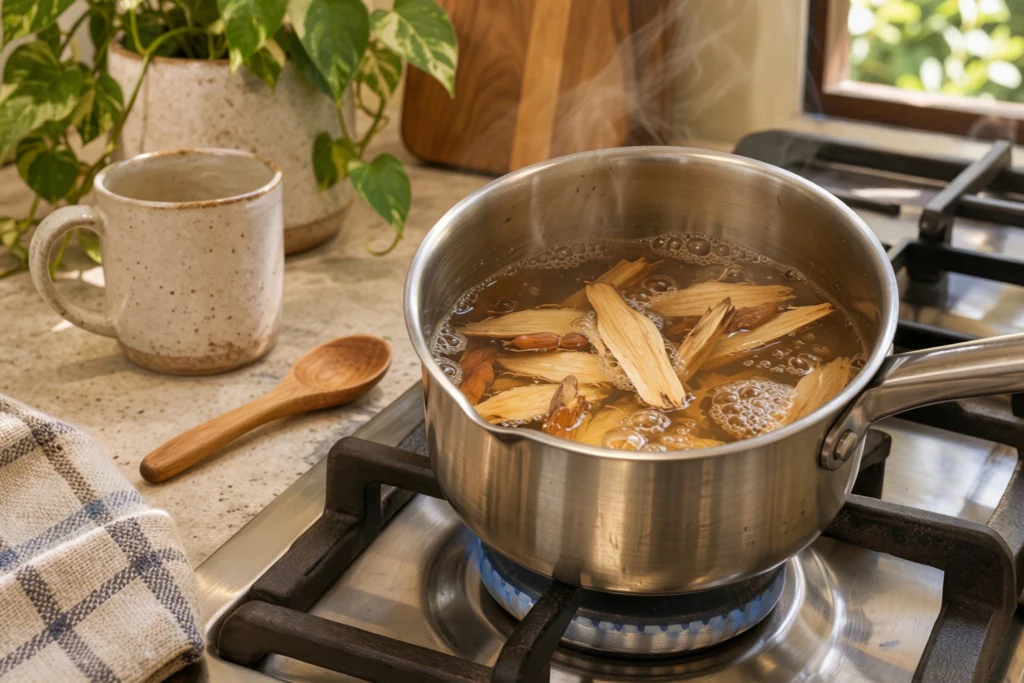
Some people simmer dried root chips in water. That is a home version of how most extracts are made: the trials mostly used hot-water extracts of the root. The difference is that you cannot know how much of the root’s compounds ends up in your cup, and no study has tested home-made tea. If you want a dose you can repeat, an extract is the better choice.
How much tongkat ali per day
There is no official recommended dose. Trials of standardised extracts have used 100 mg to 600 mg a day. How much you take should follow your product’s label, since extract strengths differ.
- Start low. Take the lower end of the label dose for the first week and see how you feel.
- Follow your product’s label. Milligrams only compare between products of similar strength.
- More is not better. There is little evidence that higher doses work better, and long-term safety at any dose has not been established.
We go through doses, cycle lengths and what the studies used in tongkat ali dosage and cycling.
What the numbers on the label mean
- Extract ratio (for example 100:1 or 200:1). This describes how much root went into the extract: 200:1 is meant to mean about 200 kg of root for 1 kg of extract. A higher ratio usually means a more concentrated product, so the same number of milligrams is not the same dose across products.
- Standardisation (for example 2% eurycomanone). Eurycomanone is one of the root’s characteristic compounds, and a percentage tells you how much the extract contains. This varies widely: the water extract used in a 2010 study contained about 0.03% eurycomanone. A stated percentage is more useful than a ratio alone.
- Testing. Look for a seller who tests for heavy metals. A Malaysian study found that 26% of 100 tongkat ali products contained more mercury than the local limit. Ours has a batch certificate with lead, mercury, arsenic and cadmium results, all within limits (available on request). More in choosing a tongkat ali brand in Australia.
With food or without
Either is fine. No study has compared the two. Most trials gave it after a meal, and mild stomach upset was the side effect most often reported, so after breakfast is a sensible default. Details in taking tongkat ali with or without food.
When to take it

Most people take it in the morning, and most of the trials gave it after breakfast or in the morning. One split the dose between lunch and dinner. No study has compared times of day, so choose a time you will remember; if it seems to keep you awake, take it earlier. See the best time to take tongkat ali.
How long before you notice anything
There is no “day one” effect in the research. Trials measured changes from two weeks to six months, and many ran for twelve weeks. Give it at least four weeks of daily use before you decide. See how long tongkat ali takes to work.
Taking breaks
All the trials used daily dosing, for up to 24 weeks. Longer continuous use has not been studied, so many people build in regular breaks. There is no research comparing cycled and continuous use; it is a precaution, not a requirement. See tongkat ali dosage and cycling.
Taking it with other supplements
Start one supplement at a time, so you can tell what is doing what. If you are considering a combination, we cover the common ones:
- Tongkat ali and fadogia agrestis
- Tongkat ali vs ashwagandha
- DHEA and tongkat ali (DHEA is a prescription-only medicine in Australia)
Before you start
- Do not take it if you are pregnant or breastfeeding. It has not been studied in pregnancy or breastfeeding.
- Medicines and medical conditions. Ask your doctor or pharmacist first. In one study, tongkat ali reduced how much of the heart medicine propranolol was absorbed.
- Long-term safety has not been well studied. The trials ran for six months at most.
Everything else is in the side effects of tongkat ali.
Frequently asked questions
How do I take tongkat ali powder?
Measure it carefully with a scoop or scale, start at the low end of the label dose, and mix it into a smoothie or coffee to hide the bitter taste.
Can I take tongkat ali every day?
Yes, daily use is how it has been studied, for up to 24 weeks. Beyond that, many people build in breaks.
Can women take tongkat ali?
Some trials included women, but research in women is limited, and it should not be taken during pregnancy or breastfeeding. See tongkat ali for women.
Is it legal to buy in Australia?
We explain the rules in is tongkat ali legal in Australia and the options in where to buy tongkat ali in Australia.
If you would rather not measure powder, our tongkat ali root extract is 500 mg of 200:1 water extract per vegan capsule, standardised to 2% eurycomanone, with no fillers and a 60 Day Wellness Guarantee.
Sources
- Talbott SM, Talbott JA, George A, et al. Effect of Tongkat Ali on stress hormones and psychological mood state in moderately stressed subjects. Journal of the International Society of Sports Nutrition, 2013.
- Chinnappan SM, George A, Pandey P, et al. Effect of Eurycoma longifolia standardised aqueous root extract-Physta on testosterone levels and quality of life in ageing male subjects: a randomised, double-blind, placebo-controlled multicentre study. Food & Nutrition Research, 2021.
- Chan KQ, Stewart C, Chester N, et al. The effect of Eurycoma longifolia on the regulation of reproductive hormones in young males. Andrologia, 2021.
- Ismail SB, Wan Mohammad WM, George A, et al. Randomized clinical trial on the use of PHYSTA freeze-dried water extract of Eurycoma longifolia for the improvement of quality of life and sexual well-being in men. Evidence-Based Complementary and Alternative Medicine, 2012.
- George A, Udani J, Abidin NZ, et al. Efficacy and safety of Eurycoma longifolia (Physta) water extract plus multivitamins on quality of life, mood and stress: a randomized placebo-controlled and parallel study. Food & Nutrition Research, 2018.
- Salman SA, Amrah S, Wahab MS, et al. Modification of propranolol’s bioavailability by Eurycoma longifolia water-based extract. Journal of Clinical Pharmacy and Therapeutics, 2010.
- Ang HH, Lee KL. Contamination of mercury in tongkat Ali hitam herbal preparations. Food and Chemical Toxicology, 2006.